Skip to content

Small apartment wall decor trends can look dreamy on a screen and feel suffocating in real life. That’s the trap: a wall treatment that adds drama in a spacious loft can turn a studio into visual noise.
The good news is that compact spaces do not need less personality. They need smarter surfaces. The right wall decor adds texture, depth, and movement without stealing breathing room from the rest of the apartment.
And that’s the real test. If a trend makes your walls work harder while your room still feels open, calm, and lived in, it earns its place.
Why Small Apartment Wall Decor Trends Fail So Often in Real Rooms
Most wall decor trends are designed for a camera, not a commute-sized living room. In a small apartment, scale matters more than style, and that’s where people get burned. A dramatic oversized print might look bold online, but in a tight layout it can swallow the room whole.
The technical idea here is visual load: how much a surface asks the eye to process at once. In plain English, the busier the wall, the smaller the room can feel. That’s why the best small apartment wall decor trends create depth without forcing your eyes to stop everywhere.
Who works with interiors knows this pattern well. I’ve seen renters buy a statement piece, hang it above a sofa, and suddenly the room feels lower, darker, and strangely cramped. The art wasn’t bad. The scale was.
According to the National Park Service’s overview of color and visual perception, color and contrast change how we read depth and space. That matters in small apartments more than people think. A wall is never just a wall when the room is 400 square feet.
1. Textured Wall Panels That Add Depth Without Extra Clutter
Texture is the quiet winner in small apartment wall decor trends. Flat walls can make a compact room feel boxy, while subtle texture gives the eye somewhere to travel. Think slatted wood, fabric panels, slim molding, limewash-look finishes, or cane details.
Texture works because it creates shadows, and shadows create depth. That gives a small room dimension without adding bulky objects to the floor. You get atmosphere, not visual baggage.
A good rule: keep the texture low-contrast and narrow in footprint. One accent wall, or even one framed section, is often enough. Full-room coverage can tip into “the wall is doing too much.”
- Best for: bedrooms, entryways, narrow living rooms
- Use when: the room feels flat or unfinished
- Avoid when: your apartment already has strong pattern, heavy furniture, or low ceilings

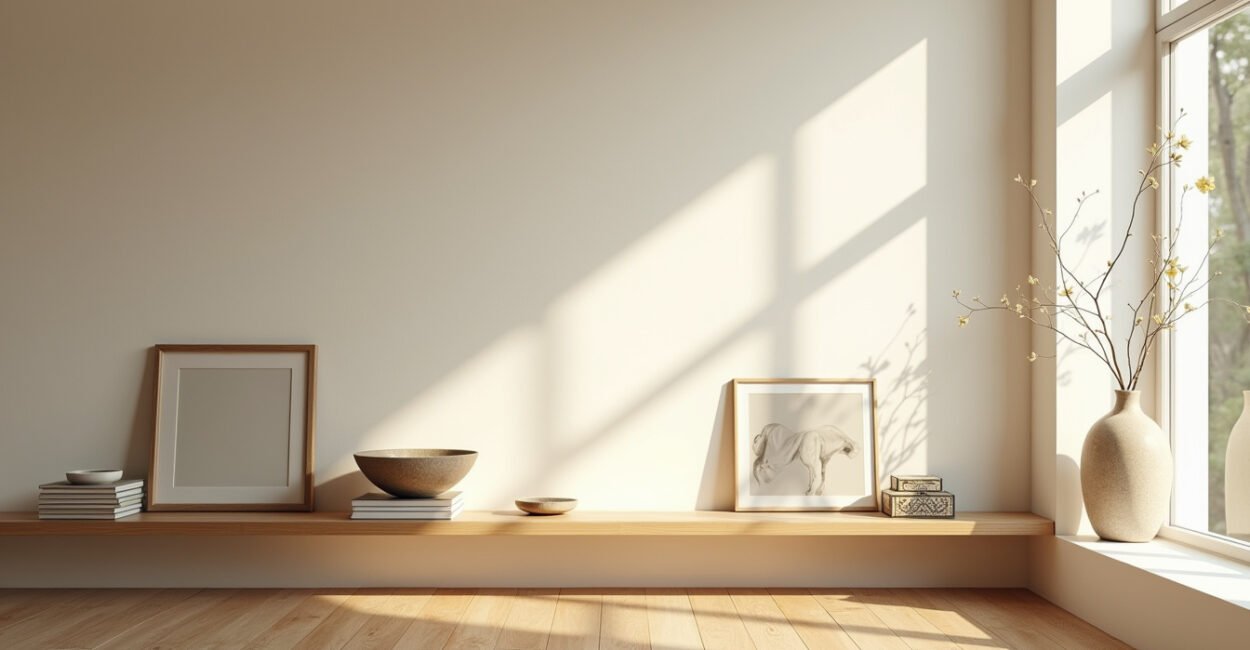
2. Oversized Art with Breathing Room Around It
This one surprises people: oversized art can actually be better than lots of tiny pieces. In small apartment wall decor trends, the problem is often fragmentation. Too many small frames chop a wall into pieces and make it feel busier than it is.
A single large piece creates one clean focal point. That reduces visual clutter and can make the room feel more intentional. It’s the wall decor version of editing a sentence: fewer words, stronger meaning.
One renter I know replaced a grid of six small prints with one large abstract canvas. The room didn’t get bigger. But it felt bigger, because the eye stopped darting around. The sofa suddenly looked anchored instead of floating in a sea of little frames.
That said, this method fails if the art is too dark, too busy, or hung too high. Leave generous margins around it, and let it breathe. The negative space is part of the design.
| Small Wall | What Works | What Usually Fails |
|---|---|---|
| Above a sofa | One large piece or a diptych | Five tiny frames in a tight cluster |
| Narrow hallway | Tall vertical art | Wide, crowded gallery walls |
3. Mirror Styling That Makes Light Work Twice
Mirrors are not a hack. They are a tool. In small apartment wall decor trends, they remain one of the few wall elements that can change both perception and function at the same time.
A mirror can borrow light from a window and redistribute it. That is why the right placement matters more than the mirror’s shape. Put one where it reflects daylight or an attractive sightline, and the room wakes up. Put it opposite clutter, and you just double the clutter.
According to the U.S. Department of Energy on daylighting, natural light can reduce reliance on artificial lighting and improve how spaces are perceived. In an apartment, that can change the feel of an entire afternoon.
What to avoid:
- Mirrors that are too ornate for the room
- Mirrors placed where they reflect a TV glare or a messy shelf
- Multiple mirrors competing on the same wall
The best versions feel almost invisible. They expand the room without announcing themselves every time you walk by.
4. Floating Shelves Used Like Architecture, Not Storage
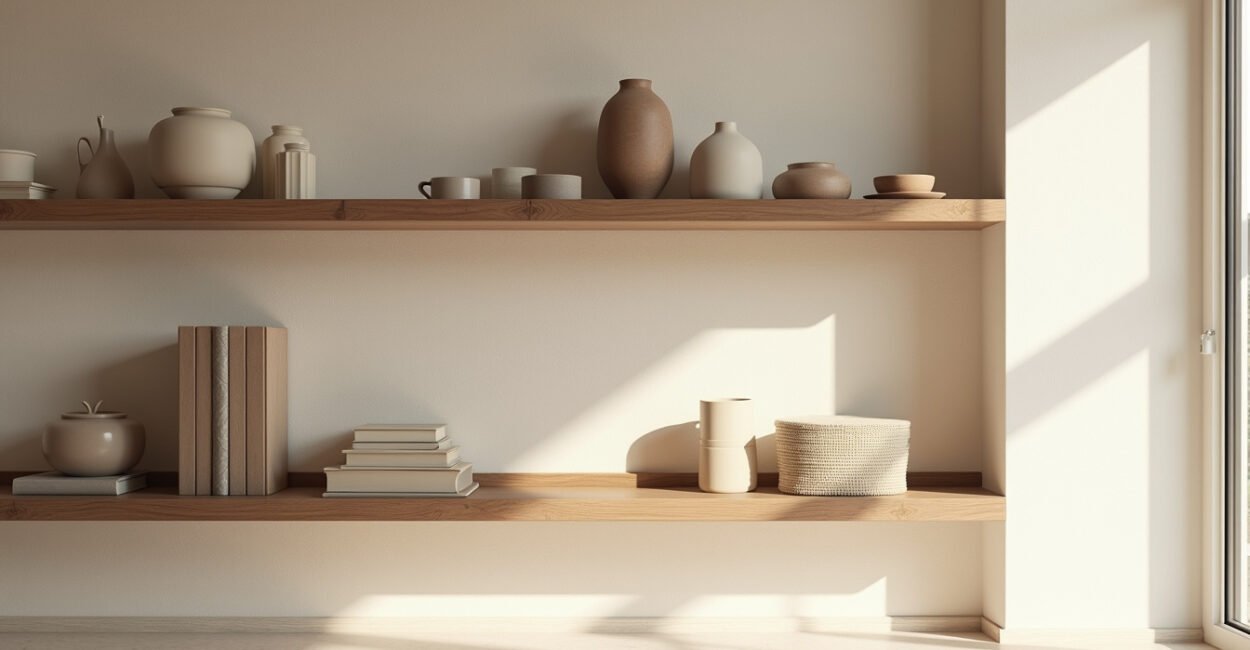
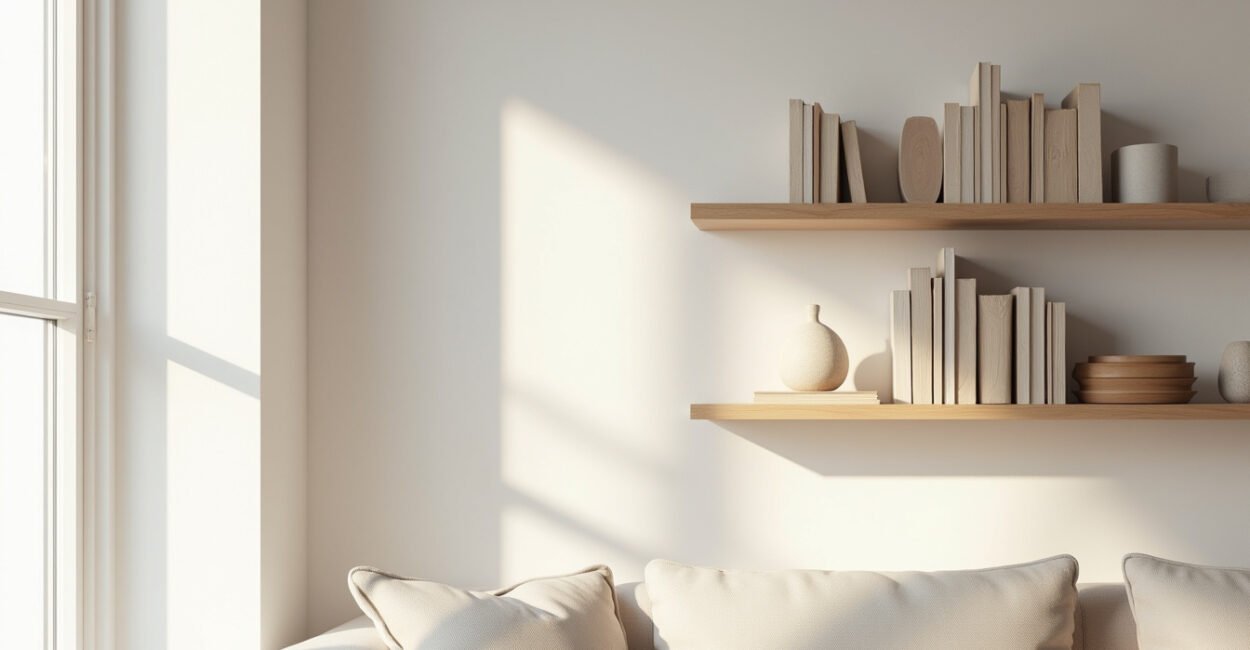
Floating shelves are one of those small apartment wall decor trends that can go either way. Done well, they create rhythm and vertical interest. Done badly, they become a landing pad for random stuff: mail, candles, stray mugs, and the decorative vase you bought because it looked “minimal.”
Think of shelves as composition, not storage. In a small apartment, every shelf needs a job. One shelf can hold a plant and two books. Another can frame a corner. That’s enough. More items do not equal more style.
Here’s the trick: stagger height and leave empty space between objects. That emptiness is doing real work. It keeps the wall from feeling packed, which is exactly what compact rooms cannot afford.
Common mistakes to avoid:
- Installing shelves too high, where they feel detached from the room
- Filling every inch with objects
- Using heavy brackets that make the shelves look bulky
When shelves are used with restraint, they add structure. When they’re overloaded, they become visual static.
5. Soft, Tactile Wall Hangings That Warm Up Hard Surfaces
Hard surfaces dominate most apartments. Paint, drywall, glass, tile, metal. That’s why textile-based decor has earned a serious place in small apartment wall decor trends. A woven hanging, tapestry, or stretched textile softens the room in a way framed prints cannot.
Fabric introduces warmth without bulk. It absorbs a little visual noise, which makes the room feel calmer. That matters in compact spaces, where echo, shine, and hard edges can make everything feel sharper than it should.
Mini-story: a friend of mine had a tiny living room with a glossy coffee table, a leather chair, and bright white walls. It looked clean, but cold enough to make the space feel unfinished. She added one neutral textile wall hanging above the sofa. That single change made the room feel intentional, lived in, and far less sterile. Nothing got bigger. Everything got better.
This trend works best when the palette stays quiet. Cream, sand, charcoal, muted rust, and dusty blue tend to hold up well. Loud patterns can overpower the room if the rest of the space is already busy.
6. The Mural Trend That Only Works When It Stays Subtle
Murals can be beautiful, but they are risky in small apartments. The bold versions you see online often rely on scale, ceiling height, and open floor plans. That’s a luxury compact spaces usually do not have.
The winning version is tonal, not theatrical. A soft color wash, a faded geometric shape, or a hand-painted arch can suggest depth without turning the wall into a billboard. In small apartment wall decor trends, restraint is usually smarter than spectacle.
There’s a myth that murals automatically make a room more creative. Reality: they only work when the rest of the room stays quiet. If your furniture, rug, and accessories already carry strong pattern or color, a mural may tip the space into overload.
Use murals where they can guide the eye, not trap it. A soft backdrop behind a bed or desk can define a zone without adding another object to the room.
In compact homes, the best wall decor is rarely the loudest thing in the room. It is the piece that makes everything else look better.
7. Layered Frames and Mixed Materials That Feel Collected, Not Crowded
Layering is where small apartment wall decor trends get interesting. The trick is not more stuff. It is better relationships between things: wood against paper, metal against linen, matte against glossy, art against empty space.
The goal is a collected look, not a crowded one. You want the wall to feel like it evolved over time, even if you set it up in one afternoon. That means varying frame widths, alternating orientations, and keeping a clear visual hierarchy.
Some designers swear by matching frames for order. Others prefer mixed materials for warmth. Both can work. There’s divergence here, and the right answer depends on your furniture and light. A very small room with heavy furniture often benefits from lighter, more consistent framing. A room with plain pieces can handle more variety.
Use this simple filter before hanging anything:
- Does each piece earn its place?
- Is there enough empty wall around the cluster?
- Does the arrangement feel calm from across the room?
If the answer to any of those is no, the wall is probably doing too much.
What Smart Small-Apartment Styling Always Gets Right
The strongest small apartment wall decor trends share one rule: they add character without competing for attention. That sounds simple, but it changes everything. In a compact apartment, the wall is not a backdrop. It is part of the room’s breathing system.
So the better question is not “What trend looks good?” It is “What trend makes this apartment feel less cramped and more alive?” Those are not the same thing. And in small spaces, the difference decides whether the room feels styled or just crowded.
FAQ
What Wall Decor Makes a Small Apartment Feel Bigger?
Large-scale art, mirrors, and subtle texture usually help most. They reduce fragmentation and guide the eye in a cleaner path, which makes the room feel less chopped up. The key is not adding more objects, but choosing pieces that create depth and light without crowding the wall. In small apartment wall decor trends, that balance matters more than matching every item.
Are Gallery Walls a Bad Idea in Small Spaces?
Not always, but they are easy to overdo. A gallery wall works best when the frames are closely coordinated and there is enough breathing room around the cluster. If the wall already sits in a busy area, a single large piece may do the job better. The danger is visual noise, not the format itself.
Should I Use Dark Wall Decor in a Compact Apartment?
Yes, if you use it with restraint. Dark frames, deep-toned art, or a moody accent can add contrast and sophistication. The problem shows up when too many dark elements fight for attention or the room lacks natural light. In that case, the space can feel smaller and heavier than it really is.
Do Floating Shelves Actually Work in Tiny Apartments?
They do, but only when treated like display space, not extra storage. A few well-chosen objects can add structure and personality without taking up floor area. When shelves get overloaded, they become visual clutter and make the wall feel busy. The best version leaves empty space on purpose.
What is the Safest Wall Decor Trend to Try First?
Textured but restrained pieces are usually the safest starting point. Think a woven hanging, a slim mirror, or one oversized print with clean space around it. These choices add style without forcing a major commitment, and they tend to work across different layouts. For renters especially, that flexibility is a big advantage.