 Skip to content
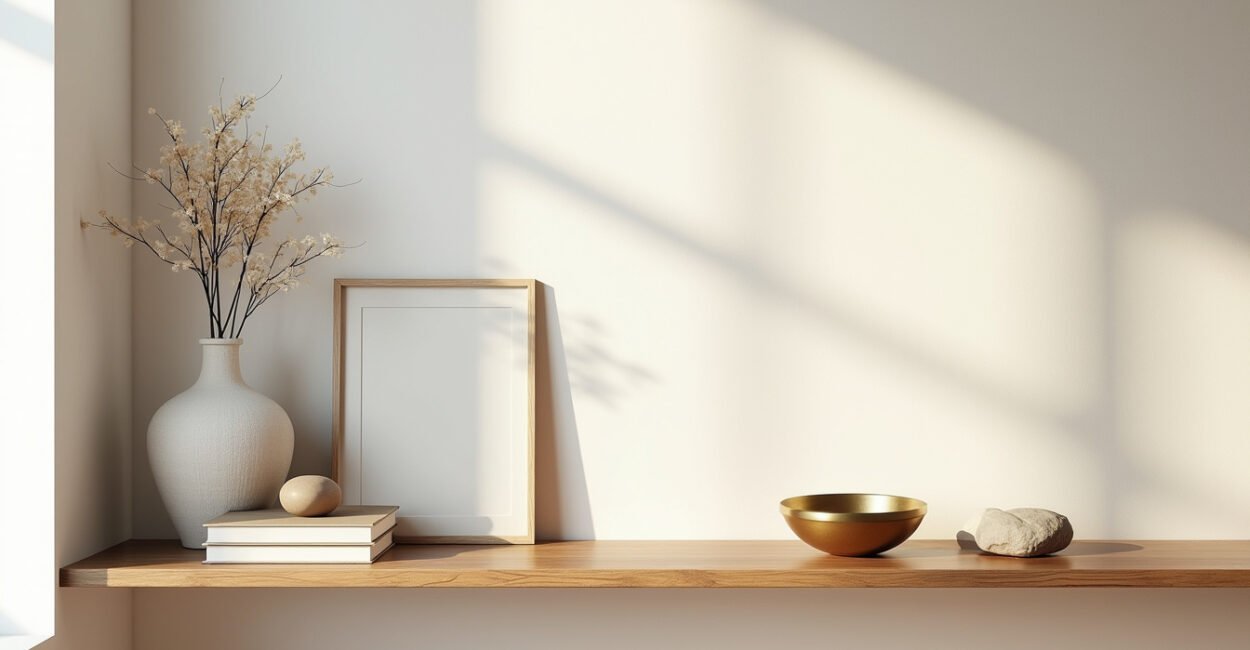
Most shelf decor looks crowded for one reason: it breaks proportion before it ever finds rhythm.
If a shelf feels “off,” it usually isn’t the objects. It’s the spacing, scale, and repetition fighting each other. The fix is simpler than most people think: use seven rules, not random styling.
That framework is what turns a shelf from “stuff on a board” into something that feels calm, edited, and intentional.
Start with Proportion, Not Pretty Objects
In shelf decor, proportion is the relationship between the objects, the shelf itself, and the empty space around them. That sounds technical, but in plain English it means this: if one vase is trying to compete with five little frames, the whole display loses balance.
Rule 1: Match the scale of the items to the size of the shelf. A wide shelf needs at least one piece with visual weight, such as a stack of books, a tall vase, or a framed print. A narrow shelf needs fewer pieces and more breathing room. Otherwise, everything starts looking like it’s packed for a move.
A quick test helps: if you cover one object with your hand and the arrangement suddenly feels better, that object was probably too loud. That is the kind of quiet correction good shelf decor depends on.
Use Seven Rules That Keep the Display from Feeling Crowded
Here’s the framework that works in real homes, not just styled photo shoots. These seven rules are practical because they solve the three things most shelves get wrong: proportion, rhythm, and breathing room.
- Rule 1: Mix heights, but keep one clear tallest point.
- Rule 2: Repeat one material or color so the eye has a thread to follow.
- Rule 3: Leave visible gaps; empty space is part of the design.
- Rule 4: Group in odd numbers when possible.
- Rule 5: Anchor with one heavier object, then build around it.
- Rule 6: Vary texture so the shelf doesn’t go flat.
- Rule 7: Stop before it feels “finished.” That last object is often the mistake.
The best shelf decor usually feels 10% underfilled. That tiny gap is what makes the styling feel relaxed instead of staged.
There’s a reason designers keep coming back to visual balance: the eye wants a path, not a pile. According to the NN/g overview of visual hierarchy, people scan by cues like size, contrast, and spacing. Shelves work the same way.

Build Rhythm with Repetition, Then Break It Once
Rhythm is what keeps shelf decor from feeling accidental. It’s the repeated element that tells your eye, “You’re still in the same family.” That might be a black frame on one shelf and a black lamp base nearby, or two ceramic pieces in the same muted tone.
Then you break the pattern once. That’s the interesting part. If everything is symmetrical and matched, the shelf looks stiff. If nothing repeats, it looks chaotic. The sweet spot is repetition with one small interruption.
Think of it like music. A shelf with no rhythm is noise. A shelf with too much rhythm is a loop. You need one note that changes the beat.
Last month, I watched a living room shelf go from cluttered to calm in under ten minutes. The owner had twelve small objects lined up shoulder to shoulder. We removed four, kept three in one color family, and gave the remaining pieces space to breathe. The shelf didn’t need more style. It needed fewer decisions.
Make Breathing Room Non-Negotiable
Breathing room is not “empty space because you ran out of ideas.” It is a design tool. In shelf decor, it gives the eye a place to rest, which makes every object you do keep feel more deliberate.
Try this: after arranging a shelf, step back and look for the spots where your eye gets stuck. Usually that’s where two objects are too close together, or where a small item is hiding beside a large one. Pull them apart and let the shelf exhale.
Common mistakes show up fast when you use this rule:
- Putting every object at the front edge of the shelf
- Filling every gap with “just one more thing”
- Using too many tiny pieces with no anchor item
- Ignoring negative space entirely
There’s also a practical side to this. The bookshelf styling advice from Architectural Digest repeatedly emphasizes spacing and edit discipline for a reason: a styled shelf needs restraint more than inventory.
Finish by Editing Hard, Then Checking the One-Glance Test
The final rule is the one most people skip: edit harder than you think you should. Shelf decor rarely improves when you add. It improves when you subtract the thing that is slightly too tall, too shiny, too busy, or too small to matter.
Rule 7 is the hardest one: if a shelf looks almost right, remove one item before adding one. That single move often fixes proportion and rhythm at the same time.
Here’s the one-glance test. Walk past the shelf at normal speed. If the arrangement reads as one clean composition, you’re done. If your eye hops from object to object without landing anywhere, the shelf needs more space or fewer pieces. That’s the whole game.
Great shelf decor doesn’t look full. It looks edited.
And that’s why the best displays feel quiet, not empty. They have a pulse, but they never shout.
FAQ
How Many Items Should I Put on One Shelf?
There is no perfect number, but fewer than you think usually works better. Most shelves look stronger with three to five intentional pieces than with a long line of small objects. The real test is whether the arrangement has a clear focal point and visible breathing room. If you can’t tell what the shelf wants you to notice first, there are probably too many things competing for attention.
What Makes Shelf Decor Look Balanced?
Balance comes from visual weight, not symmetry alone. A tall vase on one side can be balanced by a stack of books and a framed print on the other side, as long as the colors and shapes feel related. The shelf should feel steady without looking mirrored. That’s why proportion matters so much: one oversized piece can throw off the entire arrangement, even when everything else is attractive.
Should All Shelf Decor Match the Same Color?
No, but it should coordinate. A tight color palette often works better than strict matching because it gives the shelf variety without visual noise. One warm neutral, one darker anchor, and one accent tone can be enough. If every object is the exact same color, the display can feel flat. If the colors fight each other, the shelf gets busy fast. Coordination is the middle ground.
What is the Biggest Mistake People Make with Shelf Decor?
The biggest mistake is treating every shelf like a storage opportunity. That leads to rows of small objects, no focal point, and zero breathing room. Another common issue is adding too many items of the same height, which makes the display feel like a line instead of a composition. Strong shelf decor is selective. It leaves some space visible on purpose and lets a few pieces do the heavy lifting.
How Do I Know When to Stop Styling a Shelf?
Stop when the shelf looks calmer after you remove something, not fuller after you add it. If every new object makes the composition more crowded, you are past the point of improvement. The best sign is that your eye can move across the shelf without getting trapped. When proportion, rhythm, and empty space all feel intentional, the shelf is finished even if it does not feel “packed.”


