Skip to content

[A] When a living room wall climbs two stories high, the problem is not “how do I fill it?” The real question is how to give the space scale without turning it into a blank vertical tunnel. Double-height living room wall decor works best when it balances proportion, light control, texture, and a clear focal point, not when it just adds “more stuff” higher up.
In practice, the best tall-wall rooms feel finished because every large surface has a job. Some walls need art with real presence. Others need millwork, stone, shelving, or a dramatic fixture that visually pulls the ceiling down. This article breaks down what works, what fails, and how to choose treatments that look intentional instead of oversized for the sake of being oversized.
O Que You Need to Know
- On a double-height wall, scale matters more than quantity; one strong visual anchor usually beats several small objects.
- Texture often does more than color in tall rooms because it breaks up vertical emptiness without making the wall feel cluttered.
- The best solutions connect the wall to the rest of the room, including furniture height, lighting, and the fireplace or windows.
- Not every tall wall needs art all the way to the ceiling; sometimes the smartest move is to create a lower band of warmth and let the upper area breathe.
- Double-height living room wall decor fails most often when the piece is technically large but still visually too small for the architecture.
Double-Height Living Room Wall Decor: How Scale, Proportion, and Balance Really Work
A double-height wall is not just a bigger wall. Architecturally, it behaves differently because the viewing distance increases, the vertical field dominates the room, and any decoration has to compete with ceiling height, windows, and stair lines. That means proportion matters more than style. A 36-inch print can look fine in a hallway and disappear completely in a two-story living room.
The technical rule is simple: the larger the wall, the more the decor must read from across the room. In interior design terms, you are managing visual mass. That can come from one oversized artwork, a stacked composition, a vertical material treatment, or an architectural feature like paneling or a custom fireplace surround. The point is not to “cover” the wall. The point is to give the eye a clear place to land.
Start with the Room’s Primary Focal Point
If the room already has a fireplace, a full-height window wall, or a dramatic chandelier, the decor should support that anchor rather than fight it. A blank double-height wall beside a fireplace often needs only one major gesture, while a wall with no built-in feature needs stronger structure. That is why the same artwork can look stunning in one room and underwhelming in another.
Use Furniture as the Lower Frame
On tall walls, the sofa, console, and chairs are not just furniture; they are the bottom edge of the composition. When those pieces are too low or too small, the wall feels even larger. Higher-back seating, a substantial console table, or a tall bookcase can restore balance without making the room feel heavy.
On a double-height wall, the most common mistake is choosing decor by style before scale; the room reads proportion first and decoration second.
Artwork That Fills Vertical Space Without Looking Forced
Large art works best when it has presence, clear margins, and enough negative space around it to breathe. A single oversized canvas is often more elegant than a grid of small frames, especially in modern or transitional rooms. If you like collected interiors, a carefully spaced gallery wall can work too, but it needs discipline. Randomly stacked family photos usually collapse into visual noise on a wall this large.
Choose One of Three Art Strategies
- Oversized single piece: Best for modern, minimalist, or dramatic interiors. It gives the room one strong focal point.
- Vertical diptych or triptych: Useful when you want height without relying on one giant image.
- Curated gallery wall: Works best when aligned to a clear grid, a staircase, or the room’s central axis.
Mind the Viewing Distance
At two stories high, art should still be readable from the seating area. Fine detail can disappear. Bold composition, large color blocks, and strong contrast tend to perform better than delicate linework. That is why museum-scale photography, abstract canvases, and architectural prints often work better than small illustrative pieces. If you want something more personal, enlarge it. A small piece framed bigger will still look small.
A practical tip: stand where the main sofa sits and look up. If the art feels like it is floating instead of anchoring the wall, it is probably undersized. That test catches mistakes fast.
When a Gallery Wall Works—and When It Doesn’t
Gallery walls succeed when the frames form a shape the eye can understand quickly. They fail when the spacing is inconsistent or the pieces are too tiny. On tall walls, a gallery wall needs a strong perimeter, not a scattered cloud of frames. Consider using identical frames, one color palette, and a vertical alignment that connects to a staircase or architectural line.
A gallery wall on a tall wall works only when the spacing is deliberate; once the gaps become random, the whole composition loses authority.

Architectural Treatments That Make the Wall Feel Built-In
Paint and art can finish a room, but architectural treatments make a tall wall feel designed from the start. That includes board and batten, vertical wood slats, picture molding, limewash, plaster, stone veneer, and custom millwork. These choices add depth, shadows, and rhythm, which is exactly what a tall empty plane needs.
In homes with strong vertical volume, architecture often outperforms ornament. A wall that feels too cavernous can become much more comfortable once its surface has texture and subdivision. The trick is restraint: too many treatments together can make the room feel busy. If you add stone around the fireplace, you may not need heavy wall paneling beside it.
Material Choices That Age Well
Natural materials tend to hold up better visually because they do not depend on trends. Limewash and plaster soften glare. Wood slats warm up modern interiors. Stone veneer creates weight around a fireplace or chimney breast. Picture molding works beautifully in traditional homes, but it needs careful proportion on tall walls or it can look too small.
For a deeper technical reference on safe mounting and layout decisions, the U.S. Consumer Product Safety Commission has helpful guidance on preventing tip-over and wall-mount hazards in homes: CPSC tip-over prevention guidance. Tall-wall decor is not just about appearance; heavy objects need proper anchoring.
Where Millwork Makes the Biggest Difference
Millwork is especially effective when the wall has little natural structure. A plain two-story wall beside a staircase or TV niche can feel more grounded after adding vertical paneling or custom built-ins. It gives the eye a scale reference. That said, this method works best in homes where permanence is welcome. If you change style often, paint and art are easier to update than built-in detailing.
Lighting That Pulls the Ceiling Down Visually
Lighting is one of the most underrated tools for double-height walls because it changes how tall the space feels. A dramatic chandelier, a pair of sconces, or uplighting behind plants and sculpture can reduce the sense of emptiness. Light creates layers, and layers make large spaces feel lived in.
High ceilings also need light at multiple levels. One pendant alone rarely solves the problem. Instead, think in three bands: ambient light up high, task or accent light in the middle, and table or floor light lower down. That structure helps the room feel connected from floor to ceiling.
Best Lighting Moves for Tall Walls
- Oversized chandelier: Excellent when the room has a central seating plan and the fixture can hang low enough to matter.
- Wall sconces: Useful for fireplace flanks, art highlighting, and creating vertical rhythm.
- Picture lights or art lights: Best for oversized artwork or a curated display wall.
- Uplights: Good for trees, large plants, or sculptural objects that need more presence after dark.
One nuance: lighting should not “fight” the architecture. If the ceiling already has a strong chandelier, adding too many dramatic wall fixtures can make the room feel overdesigned. The better move is often one hero fixture plus quiet supporting light.
For broader lighting standards and safety guidance, the U.S. Department of Energy’s lighting guidance is useful when choosing efficient, layered light sources for large rooms.
How to Use Color, Texture, and Contrast Without Overloading the Room
On a double-height wall, color does not have to be loud to have impact. In many homes, the best result comes from controlled contrast: a lighter wall with darker art, a moody accent wall with warm wood, or a textured neutral that changes with daylight. A tall wall eats weak color choices. Flat beige on a huge vertical plane often looks unfinished, while a tone with depth can feel tailored.
Texture matters because it registers at a distance. Venetian plaster, linen wallcoverings, ribbed wood, and textured paint all create depth without screaming for attention. That is especially useful if your room gets strong sun, since glare can flatten a painted wall and make it feel larger than it is.
Good Combinations Versus Safe Ones
| Approach | Best For | Why It Works |
|---|---|---|
| Warm white + large art | Minimal, airy rooms | Keeps the wall calm while the art carries the focal point |
| Textured neutral + wood accents | Transitional interiors | Adds softness and prevents the wall from feeling flat |
| Dark accent wall + light furniture | Rooms with lots of daylight | Makes the wall feel grounded and reduces the “towering” effect |
| Stone or plaster + restrained decor | Fireplace walls | Lets the material speak without visual competition |
Here is where a lot of people go wrong: they choose a color because they like it in a swatch, not because it solves the room. A soft charcoal might be perfect in a south-facing room with huge windows and terrible in a north-facing room that already feels cold. That is why finish samples should always be tested on the actual wall.
Staircases, Shelving, and Other Vertical Elements That Belong on Tall Walls
If the wall sits near a staircase, built-in shelving, or a loft opening, those elements should be part of the decor strategy from the beginning. A staircase creates movement, so the wall can handle more rhythm. Open shelving adds personality, but only when it is edited. Too many small objects on tall shelves look cluttered fast.
Vertical elements are useful because they create a human scale inside a large envelope. A tall wall without any mid-level interruption can feel like a lobby. Adding a sculptural ladder bookcase, a recessed niche, or staggered shelving helps the eye move naturally through the space.
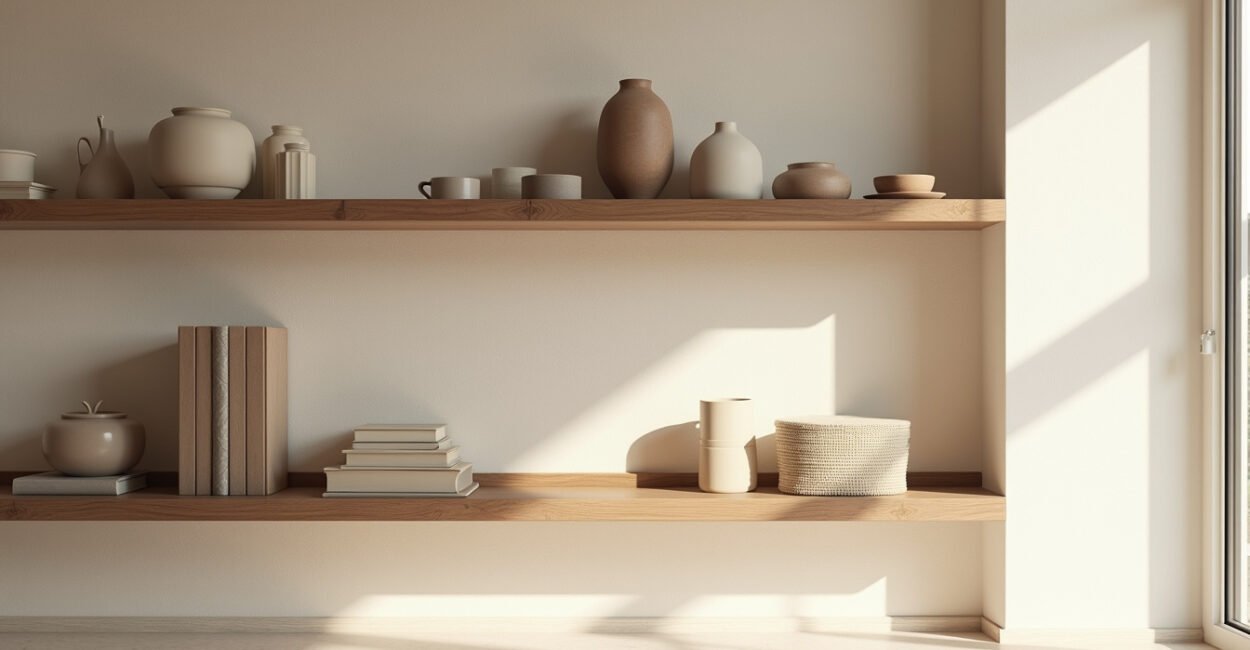
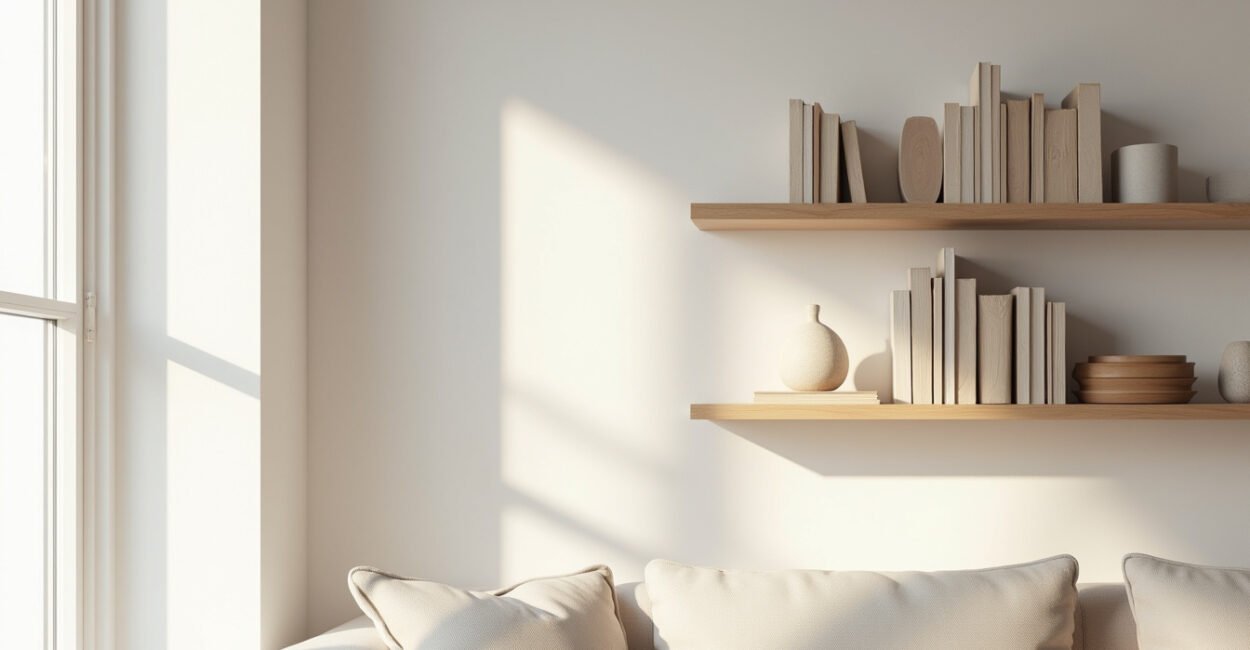
What to Put on Shelves in a Tall Room
- Large books with strong spines and real visual weight
- One or two oversized vessels instead of many tiny accessories
- Sculptural objects with simple silhouettes
- Stacked trays, boxes, or framed art leaned against the back panel
Mini-Story: A Room That Finally Felt Finished
In one project, a family had a two-story living room with a blank wall beside the stairs. They kept buying small framed prints and moving them around, but nothing looked right. We replaced the scattered pieces with one tall oak console, a pair of oversized abstract canvases, and a slim wall sconce centered between them. The room did not get “fuller” so much as it got clearer. That is the effect you want.
That kind of result is common. When the wall has too many tiny signals, it feels unsettled. When it has one or two strong vertical moves, the whole room relaxes.
Common Mistakes That Make Tall Walls Look Smaller
The fastest way to make a double-height wall look awkward is to decorate it as if it were a normal wall stretched upward. Small artwork, tiny sconces, narrow mirrors, and low furniture all shrink the room visually. Another common mistake is filling every inch. Empty space is not a flaw here; it is part of the composition.
There is also a practical limit. Not every wall needs a large statement piece, and not every design benefits from symmetry. If the architecture is already strong, the decor should stay quieter. If the room is exposed to lots of natural light, some finishes may wash out by midday. That is one reason designers often test materials at different times of day before committing.
The Mistakes I See Most Often
- Using art that is too small for the viewing distance.
- Hanging decor too low, which leaves the upper wall visually stranded.
- Mixing too many finishes, which turns the wall into a sample board.
- Ignoring the scale of the furniture below the wall.
- Choosing decor that looks good online but disappears in the room.
The empty upper portion of a tall wall is not wasted space; it is what gives the room breathing room and keeps the composition from feeling cramped.
How to Choose the Right Approach for Your Room
The smartest way to style a tall living room wall is to match the solution to the architecture, not to a trend photo. A room with a fireplace often wants material and balance. A room with a staircase may want movement and vertical rhythm. A room with dramatic windows may need only restrained art and layered lighting. The right answer depends on how the room already behaves during the day and at night.
Before you buy anything, stand in three places: the main seating area, the entry point, and the staircase or hallway approach if there is one. If the wall looks empty from one angle but cluttered from another, the design is probably trying to do too much. The best double-height living room wall decor feels calm, not crowded, and it looks finished from the first glance.
For layout and safety details that matter when mounting large pieces, review the National Park Service guidance on safe hanging and mounting principles. Heavy art and tall installations need proper support, especially over traffic areas.
Próximos Passos for a Taller, Warmer Wall
If you want the room to feel more polished this week, start by identifying the wall’s real job: focal point, backdrop, or connector. That one decision cuts through most of the uncertainty. Then choose one strong move—oversized art, architectural treatment, or layered lighting—and let the wall breathe around it. The goal is not maximum coverage. It is visual confidence.
Before making permanent changes, mock up the composition with painter’s tape, paper cutouts, or removable hooks. That small test catches proportion problems before they become expensive ones. If the wall still feels unresolved after that, the answer is usually not more decor. It is better scale, better placement, or a more substantial material.
Frequently Asked Questions
What is the Best Decor for a Double-height Living Room Wall?
The best decor is usually one large, clearly anchored feature rather than many small pieces. Oversized artwork, custom millwork, or a textured architectural finish tends to work better because it reads at a distance. The right choice depends on the room’s focal point, furniture scale, and how much natural light the wall receives. If the wall already has strong architecture, keep the decor simpler.
How Big Should Art Be on a Tall Living Room Wall?
Art should feel substantial from the main seating area, not just look large in a catalog. As a rule, small prints almost always disappear on a double-height wall unless they are part of a deliberate gallery system. A single oversized canvas or a vertical pair of pieces often performs better. The most reliable test is to view it from across the room and check whether it visibly anchors the wall.
Should I Fill the Entire Wall from Floor to Ceiling?
No, and that is where many rooms go wrong. Filling the entire height can make the space feel busy, overworked, or oddly compressed. Leaving some upper wall blank gives the room breathing room and helps the composition look intentional. In most homes, a strong lower and middle section with a quieter upper zone creates the best balance.
Do Built-ins Work on Double-height Walls?
Yes, built-ins can work very well if the room needs structure and storage. They are especially effective near fireplaces, staircases, or walls that feel too empty for art alone. The key is proportion: built-ins should look like part of the architecture, not a furniture set pushed against a giant wall. If they are too low or too narrow, they can make the wall feel even taller.
What Should I Avoid on a Tall Living Room Wall?
Avoid decor that is small, scattered, or visually weak from a distance. Thin mirrors, tiny framed prints, low sconces, and random accessory groupings usually make the wall look underdesigned. It also helps to avoid mixing too many finishes unless you have a clear plan. The wall should feel edited, not decorated in layers with no hierarchy.